

Chlorine vs. Chloramines: Why the Difference Matters for Your Home's Water
July 30, 2026
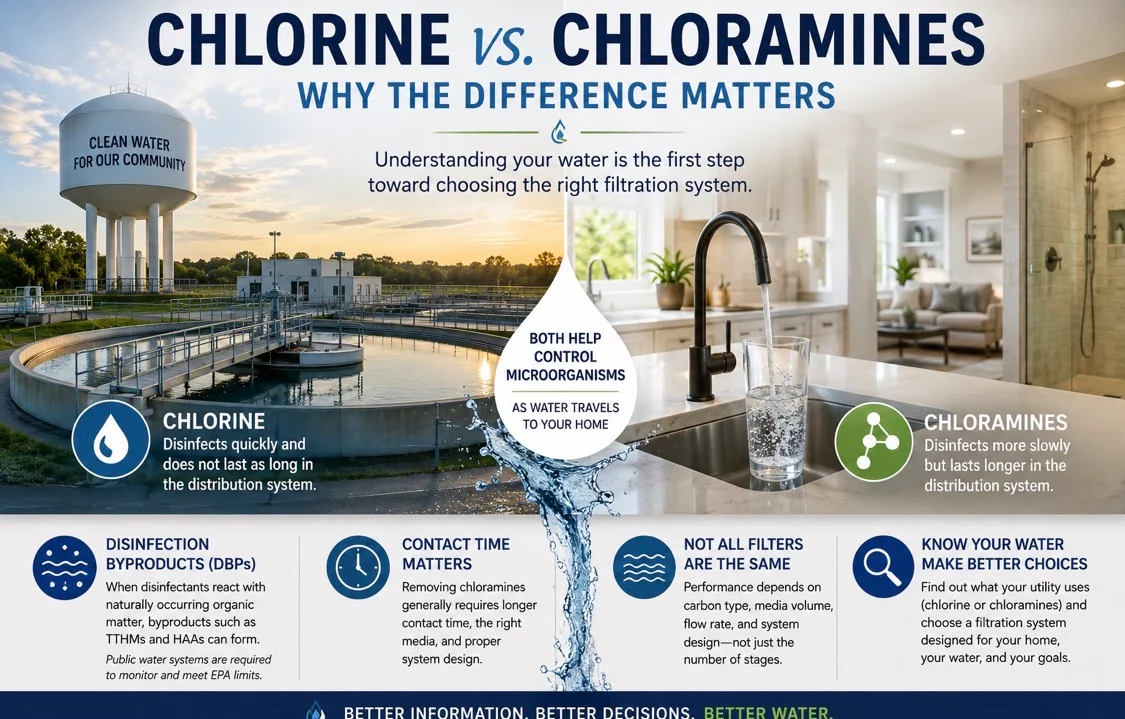
Most public water systems use a disinfectant to help control bacteria, viruses, and other microorganisms before water reaches homes and businesses.
Two commonly used disinfectants are free chlorine and chloramines. Although they serve a similar purpose, they behave differently in the water distribution system—and those differences can matter when selecting a home water filtration system.
Why Do Water Utilities Use Chlorine?
Chlorine has been used in public drinking-water treatment for more than a century. It acts quickly and effectively against many microorganisms that could otherwise be present in untreated water.
Utilities generally maintain a low disinfectant residual as water travels through the distribution system. This remaining disinfectant helps control microbial growth as water moves through miles of pipes before reaching the tap.
Why Do Some Utilities Use Chloramines?
Chloramines are most commonly formed when ammonia is added to chlorine during the water-treatment process.
Compared with free chlorine, chloramines remain active longer as water moves through a distribution system. That longer-lasting residual can help utilities maintain disinfection in large systems or in areas where water must travel greater distances before reaching customers.
A utility may use chlorine, chloramines, or different disinfection methods at different points in its treatment and distribution process.
What Are Disinfection Byproducts?
Chlorine and chloramines are reactive disinfectants. When they interact with naturally occurring organic or inorganic material in source water, compounds known as disinfection byproducts, or DBPs, can form.
Two commonly regulated groups of disinfection byproducts are:
- Total trihalomethanes, commonly called TTHMs
- Haloacetic acids, commonly called HAA5
The types and amounts of byproducts that form can vary depending on the disinfectant used, the characteristics of the source water, treatment conditions, temperature, pH, and the amount of time the disinfectant remains in the water.
Public water systems are required to monitor regulated disinfection byproducts and comply with applicable U.S. Environmental Protection Agency standards.
Disinfection therefore involves an important balance: utilities must control microorganisms while also managing the formation of regulated byproducts.
Why Chlorine and Chloramines Behave Differently in Filtration
A common misconception is that every carbon-based filtration system performs the same way.
It does not.
Free chlorine is generally more readily reduced by many activated-carbon filtration products. Chloramine is more stable and can require a different carbon formulation, sufficient media capacity, appropriate system sizing, and suitable operating conditions.
A product that is designed only for chlorine taste and odor reduction should not automatically be assumed to provide the same performance for chloramines.
This is why homeowners should first determine which disinfectant their local water utility uses and then review whether a proposed filtration system has documented performance for that specific disinfectant.
What Does “Contact Time” Mean?
Contact time refers to the opportunity water has to interact with the filtration media as it passes through a system.
It can be influenced by several factors, including:
- The type and quantity of filtration media
- The size and configuration of the filter
- The water’s flow rate
- The incoming disinfectant concentration
- Water temperature and chemistry
- The age and condition of the filtration media
- The household’s water-use patterns
Adequate contact between the water and the appropriate filtration media can be important, particularly when chloramine reduction is a treatment goal.
However, contact time should not be considered by itself. More media, a larger housing, or a slower advertised flow rate does not automatically guarantee better performance.
The complete system must be properly designed, installed, operated, and maintained.
Why System Design Matters
Two filtration systems may both advertise carbon filtration but perform differently under the same household conditions.
Important differences may include:
- The type of activated or catalytic carbon used
- The amount of usable filtration media
- The system’s rated service flow
- The contaminant concentration entering the home
- The condition of the water
- Cartridge or media replacement intervals
- Independent testing or certification for specific reduction claims
The number of filtration stages alone does not establish how well a system will perform. What matters is what each stage is designed to accomplish and whether the system has appropriate support for its stated performance.
How Can You Find Out What Your Utility Uses?
Your water utility’s annual Consumer Confidence Report may identify the disinfectant used and provide testing information for regulated contaminants and disinfection byproducts.
Because treatment methods can differ by utility—and may occasionally change—it is helpful to review the most recent report or contact the utility directly.
Water testing at the home may also provide additional information about the conditions present at a particular property.
The Bottom Line
Chlorine and chloramines serve an important role in public water treatment by helping control microorganisms as water moves through the distribution system.
However, they are not identical. They differ in stability, persistence, and how they respond to filtration.
That is why selecting a home water-treatment system should begin with understanding the local water supply.
When chlorine or chloramine reduction is a goal, homeowners should consider the filtration media, system design, service flow, maintenance requirements, and documented performance—not simply the size of the equipment or the number of stages advertised.
At Pure Home 365, we believe better decisions begin with better information. Understanding how your local water is treated is an important first step toward selecting a solution designed around your home, your water conditions, and your treatment goals.
Filtration performance varies by product, water conditions, flow rate, usage, installation, and maintenance. Consult applicable product performance data and replacement recommendations when evaluating a water-treatment system.